The Myth of Overpopulation

Posted: 5 June 2013

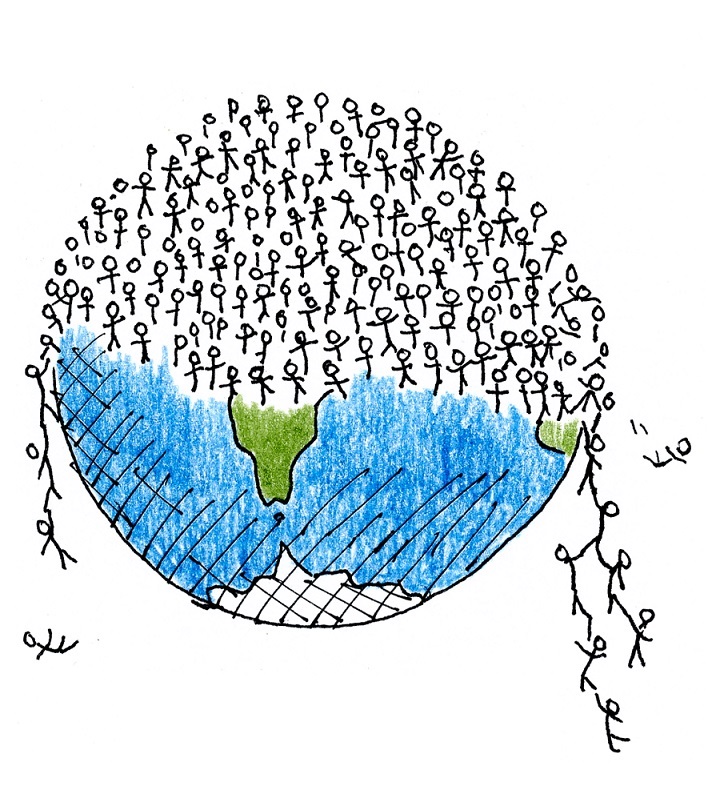
overpopulation PicAustralia recently welcomed its 23 millionth citizen. Of course we do not know who this person is exactly but they are out there somewhere. The person may have been a new born baby or possibly an immigrant who relocated to call Australia home. The news reports generally seemed to have been positive, or at least neutral, about our growing population numbers, which are still rather small compared to other nations. The same positivity was certainly not present when the global population ticked over to seven billion in early 2012. At that time there were renewed warnings from some quarters that earth could no longer continue with so many humans moving in.

Talk of overpopulation is nothing new. One of the foundational works on the subject was published in 1798 by an English Vicar named Thomas Malthus. Malthus believed that unchecked population growth would lead to a reduced standard of living and he actually advocated the death of poorer members of society so that those of a higher social status would not starve. Malthus predicted that society was about to reach a point where the planet would no longer be able to produce enough food causing worldwide starvation. Although his predictions of a global meltdown never came true, Malthus is still cited as an authoritative reference for those who advocate the forced curbing of population growth.

What Malthus could not have envisaged was the way that the industrial revolution would so impact the ability of man to produce food. Both of the world’s leading authorities on food distribution today are very clear that there is enough food for everyone on the planet. The United Nations Food and Agricultural Organisation states the problem quite simply, “the world currently produces enough food for everybody, but many people do not have access to it”. In other words poverty stemming from a lack of food should not exist. Thanks to modern methods of farming, the world is producing hundreds of millions of tonnes more food each year on less land than was used thirty years ago. Just because the world has a greed and distribution problem though does not mean that the world has a population problem.

If we actually do some simple math on the question of population it may surprise you to know that the entire population of the planet could fit into the state of Queensland with plenty of room. Queensland is approximately 1.7 million square kilometres, or 1700 billion square metres. If this figure is divided by the current population of 7.1 billion every individual person would have 239 square metres for themselves. And if we further acknowledge that many of these people would live as families in common houses, there would be enough space for everyone to live comfortably in a full sized house with a large backyard. Now of course if that was to happen the state of Queensland would require much new infrastructure but the point of the example is that there is plenty of room on planet earth for all of us and more. It is true that our cities are overcrowded but that is because humans are of their nature communal beings. We like living in close proximity to others so the fact that the main roads are crowded each morning does not mean that forcing families to have less children will solve the problem. More likely, cities will always be congested and there will be a greater need for government to support the growth of new regional centres.

The reality is that more serious than any overpopulation problem is the global shrinking birth rate. To simply replace ourselves each childbearing woman must have 2.1 children however as of 2010 about 48% of the world’s nations have sub-replacement fertility levels. Virtually every European nation as well as Japan, Russia and Australia are not having enough children to replace their ageing populations. Some countries are now seeing the need to pay subsidies to couples who have more than two children.

It is wrong to think that people only consume resources and destroy nature. People are the world’s greatest asset because each new life offers a potential creativity and giftedness that did not exist before. More people do not equal greater poverty, on the contrary, it is the enlarging of community and the building up of nations that offer the greatest opportunities for people to live happy and successful lives. Overpopulation has always been, and remains, a myth perpetuated by ignorance, greed and fear.

Comments are closed.

Lent and the Cross

Posted: 5 April 2013

crossWe are rapidly progressing through the season of Lent and if we have been taking the season seriously, the physical and spiritual efforts we have undertaken are probably being felt. This exercising of the spirit is much like exercising the body.  Initially when we start a fitness regime, maybe running or swimming or a particular group sport it can be tough, we cannot go as far as we would like, but as we keep working at it, little by little, our ability becomes greater, the distractions and bothers fall away.  This is the Church’s hope for us, that by now we are starting to grow stronger in virtue, but we must keep the cross before our eyes to remind us of why we are suffering and of whom we suffer with. Everything done in Lent has to be done for Christ and with Christ. One might live on bread and water for forty days but if that suffering is not united with Christ’s suffering then all that has been achieved is most probably significant weight loss.

Each one of us is called during this Lent to wait on the Lord, for our sufferings are not meaningless, but the very opportunities that God allows to unite us to him. Sure, we were not created to suffer but we live in a fallen world and now the only way to overcome our fallenness and be united with the Trinity is through the cross. There is no other method; no pill, no book, no website, no self-help DVD and not even another person. By allowing himself to be hung nailed to a tree Christ wanted to show us that happiness in this life – and salvation in the next – comes through waiting on God.  The cross is the exact opposite of what happened with our first parents in the garden.

Consider what happens when we believe that we are not being fulfilled as we should. When we are unable to stand with Mary at the foot of the cross, we turn to our first parents and grasp at our own happiness. We reach out to take the fruit because we do not trust God will provide. All sin is us grasping at what we think will make us happy although we know from experience it only leaves more emptiness than before.  Think of any sin, adultery, fornication, pornography, masturbation, contraception, homosexuality, jealousy, theft.  When we give in to one of these temptations we are grasping at the happiness we think they will bring. We confuse the very good desire for happiness with the correct way to find it.  So what is the answer?  It is the cross. There can be no other answer.

God does not want us to suffer and God does not want us to be lonely. It is from the cross we are reassured that from death comes life, from crucifixion comes resurrection, from the battle comes the crown.

So as we continue to move through Holy Lent it is the time to remind ourselves that we cannot solve every problem ourselves. God knows where our heart aches and he is there with us. You might know the story of Job (he has a whole book dedicated to him in the Old Testament).  When everything goes wrong in Job’s life when he loses his land and his cattle and his family, he sits down in the ashes and from that place he worships God. From the very centre of his pain, he is able to say ‘The Lord gives and the Lord takes, blessed be the name of the Lord’. Can you do that? Each of us is called to be like Job. To sit at the foot of the cross in our sufferings and look up knowing that he who hangs on the cross knows all our sufferings.

The philosopher Peter Kreeft used these words to relay the way the suffering Christ dwells among his people. “Christ sits beside us in the lowest places of our lives. Are you broken? He is broken too. Are you rejected? He is rejected too? Do you weep? He weeps too. Was your love betrayed? Jesus loved and he was betrayed by the ones he loved. He sits with us not only in our sufferings but in our sins. No matter how much we turn our face from him he will never turn his face from us; all he does is constantly call us back to him. Every tear we shed becomes his tear. He may not wipe our tears away but he makes them his own.”

Comments are closed.

Death. A Part of Life.

Posted: 6 October 2012

imagesCAZ8XEB9

It turns out that I am dying. One day, in the not too distant future, I will be dead. It may be tomorrow or it may be in seventy years, but either way, compared with the scope of history, it will be fairly soon. It will happen to me and to you and to everyone we know. In fact from the moment we are born we are on a path towards death. Death is actually happening all around us. As you read this an old man is breathing his last breath in a nursing home and a middle-aged woman is saying goodbye to her family in a hospital. Over 150,000 deaths occur worldwide each day, yet the modern psyche seems less equipped to deal with death than ever before.

For all of history, illness, death and grief have generally taken place in the home within a family context. However, in the Western World in the last century, death and illness have been relocated behind reception desks and security staff into hospitals, nursing homes and palliative care units. People go in and bodies come out. Yet for most of us the closest we will get to that, is sitting in our car next to a windowless mortuary van at the traffic lights. Of course our progress in healthcare and nursing is a wonderful achievement but it has come at a price, that of us seeing death as a somewhat unique anomaly. This compartmentalisation of death in modern society into purpose built institutions away from ‘real life’ has resulted in a general ignorance and even fear of death.

I saw a film a few years ago titled The Waiting City in which a young Australian couple journey to Calcutta to collect their adopted baby. The film is shot entirely in India and showcases a world that is very different to the one this young couple has come from. One scene shows the funeral of a young child. While this boys dead body is pushed out on a burning pyre across the river; his young friends stand calmly on the banks and sing a Hindu funeral hymn. What stood out was the reality that these children had a greater understanding of death (and probably also of life) than most adults in the Western World.

Death is so very important; we might call it, the great leveler. At the threshold of death, all men and women must, at some point, submit. For the believer, death is the whole purpose of life, it is the entry into eternity and so all of life on earth should be lived with that in mind. Christian tradition has long encouraged the faithful to pray for a ‘happy death’, that is, the foresight to prepare now for that moment when one will stand before the Creator. For the non-believer, death provides a reminder that nothing in this world will last forever, not riches or power or even thankfully pain and suffering. Without death there would no doubt be far more tyranny, greed and selfishness. It would do all of us good on occasions, to stop and reflect on death, and to live our life with that on the horizon.

Living in the 21st century, adults who may have experienced little if any death in their life can fall into a tendency to overprotect children from the realities of grief and loss. We should of course protect children (and ourselves where possible) from gruesome and violent aspects of death, but death in and of itself is not gruesome. In our world death so often gives way to life; the branches of a plant must be pruned to allow for new growth, smaller animals are consumed by larger ones and soldiers give their lives for the lives of their countrymen.

I recall sitting before the bodies of two of my deceased grandparents and while there was the obvious sadness at the loss, it impressed upon me that their whole life and every experience had culminated at this moment. From the generosity of their lives, my own life came about and this is how it has been right back to the dawn of time. In a world that is so unrelenting and unforgiving there is something surreal about being present at a death. Through the tears it is a moment to stop and give thanks for the beauty of life. Far from shunning death and grief, our modern society may just find some much needed healing in recalling that death is an essential part of life.

Comments are closed.

Violence again Women. Australia says…Yes

Posted: 7 July 2012

Prostitutes

In 2004 the Federal Government funded a $20 million campaign with the slogan, ‘Violence against Women. Australia Say No.’ The campaign was to bring awareness of violence occurring behind closed doors. As part of the campaign a TV ad was produced with a selection of men justifying why they assaulted women and the slogan making it clear that such behaviour was not tolerable. More recently a government campaign was launched called ’The Line’ which encouraged young people to consider where they would draw the line regarding issues such as ‘hooking up’ sexually at parties. The message in response to this possible quandary was not to engage sexually with someone unless there was mutual consent.

It may seem on face value that Australia is serious about stamping out abuse but I wonder just how serious we really are. While all these sorts of campaigns are of some value they fall into the interesting category of a secular government trying to teach morality. While a government may make laws to try and enact a particular behaviour they are seemingly unable to plug the illogical and confusing holes that appear in their attempts.

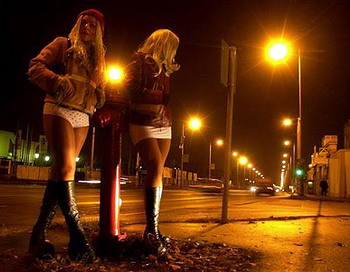
The last remaining ‘virtue’ in secular morality is consent. With consent two people can do whatever they wish, without consent, or with consent withdrawn at any time, one of those people becomes a criminal. According to the logic of the aforementioned campaigns so long as a woman says the word ‘yes’ a man is at rights to enjoy her sexually and vice versa. This would mean it is ‘moral’ for a man to go out to a different bar every night and find a woman who is lonely, needy or broken enough, that with a little kindness (and a couple of glasses of alcohol) he can have sex with on that night and walk away the next morning. If bars are not his scene he is legally able to buy consent with one of the estimated 20,000 people engaging in some form of prostitution across Australia in any one year. While it is obviously hard to gauge correct figures, one statistic to emerge from a poll was that 15 per cent of men sampled had visited a prostitute. Some samples have suggested as many as 40 per cent of the male population have visited or will visit a prostitute at some point in their life.

So whether one is obtaining sexual pleasure by scanning the bars and clubs or by scanning the Yellow Pages for ‘Adult Services’ there is no mention of what effect this has on the emotional and mental well being of vulnerable women. Completely leaving aside the social costs of marital infidelity, the fact that the rise of ‘legal’ internet pornography is changing the way men understand their own sexuality and the epidemic of sexually transmitted infections…what is this social acceptance of commitment-free sex doing to us?

Allow me to tell you what it is doing. When society advocates consent as the only moral compass and thinks that violence is only possible when someone withdraws that consent it completely negates that we are often broken and hurt people. Some of us have a tendency to use others and others of us have a tendency to allow ourselves to be used. Deep down we all want the same thing, love, but more often than not we get confused about how to find it.

The notion of free-sex and legal prostitution sends the very clear message that a person is an object and in some situations we can use them as such. While most people would not advocate me selling myself to be used as a punching bag, we seem to think it is ok to violate the body of a woman we don’t even know so long as she says yes. The word yes however is easy to say. If a woman is alone and someone is showing her attention, she may say yes. If a woman is desperate for drugs or money, she may say yes. That does not mean in any way that the actions she is saying yes to, are of benefit to her overall well being.

A nation which allows its citizens to treat the most needy and vulnerable as objects for another person’s pleasure is not a nation that genuinely understands the human condition. We can roll out all the feel-good campaigns we want about anti-violence and the importance of consent but until we acknowledge that all people, no matter how desperate they are have a right to be treated with complete dignity, then we actually do advocate certain types of violence in certain situations.

Comments are closed.

What is the point of suffering?

Posted: 5 November 2011

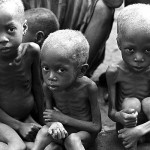
Biafra, Nov. 1969Medical clinic in Mabaitoti - Owerri.

Anyone out there had any sufferings cross their path lately? Perhaps it’s something transitory like recently losing a job. Perhaps it’s something long term like caring for someone with a disability. Maybe it’s the anxious wait to meet the right person or the heartache of dealing with marriage problems. Then of course there are the sufferings that most of us will never have to encounter such as starvation or a lack of clean drinking water. Suffering is a strange thing, it surrounds us and all of us will meet it in some shape at various points through our lives, yet most people have no idea about how to respond to it.

I recall once being down about something and a friend said to me in all sincerity “just remember that there is always someone worse off than you”. I am sure many of you have given or received similar advice. And at face value the logic is true, I am not living on a dollar-a-day in a third world country; I have a car and a house and people who love me. Surely I would be better to consider the trials of others before getting all worked up about my own sufferings?

Of all the faith systems in the world, Christianity has the most profound understanding of suffering, after all its founder was put to death and the instrument of his death – the cross – has become the enduring Christian sign. The call of Christ to “take up your cross” is a part of common speech. But what does it mean to take up our cross and how does that play into the daily sufferings we face?

Perhaps if we do not understanding suffering the best we believe we can offer is a consolation which compares sufferings. The crux of the matter though is that while God does not directly will for anyone to suffer, he does allow such sufferings and he allows them in ways that can be beneficial for us, if we embrace them in the correct spirit. Our crosses are actually specifically shaped for us, they take into account our strengths and our weaknesses and what we need (often this is very different from what we think we need). Perhaps the family with no food in Africa is objectively in a more desperate situation than I am but my particular cross is not one of starvation. It really does not matter what someone else is suffering with because what is real to me is my particular suffering in this moment, even if it is objectively less than another. I do not need someone to tell me that my cross is not the biggest cross, the fact is, it is my cross.

If we believe Christ’s command to take up our cross then it would seem we actually have a duty to embrace the particular sufferings that fall our way. I am certainly not saying that we have to desire suffering and pain, but perhaps we need to look more deeply into our particular cross to see what good is within. If we live with an attitude that refuses to accept suffering then we might actually be closing ourselves off to an important gift that has been offered to us alone. Every event we encounter is in a broad sense, sacramental, that is, it is an external sign containing within it God’s action for us.

We might consider what would have happened if Christ decided not to embrace his cross. The cross of Christ is the source of salvation, it points to a love that we will spend our lives aspiring towards. Our own crosses are our paths to salvation when taken up and united with the cross of Christ. You may know the phrase “offer it up”, it’s often something told to children who are complaining but it has a deep and lasting value that we should probably all seek to embrace in our own lives. To offer something up, from drinking cold coffee to the way we deal with tragic news, gives us an outlook that quite simply, the world cannot give.

It is not that one walks into the hospital room of a friend diagnosed with cancer and simply says “offer it up” and walks out. If though in our lives we have come to understand that our crosses can be the tools that God gives to help us towards salvation, we will be in a far better place to truly be with the one who is suffering. Instead of trying to distract the sufferer from their pain and pretend it is not as bad as it could be we can help them to see the cross before them with new eyes.

Comments are closed.